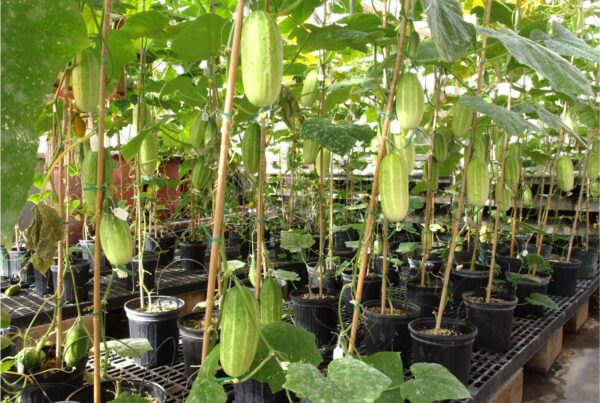

More than 1,000 plants move through a greenhouse on conveyor belts, stopping automatically to be weighed, watered and photographed from multiple angles. Each image captures clues about plant growth and responses to environmental conditions, generating data that could help researchers develop improved crop varieties. Scientists from Breeding Insight (BI) saw this technology in action during a visit to the Donald Danforth Plant Science Center in St. Louis, Missouri, in April. The teams toured phenotyping facilities, exchanged ideas on plant phenomics and image analysis tools and identified opportunities to combine their expertise to advance plant breeding.
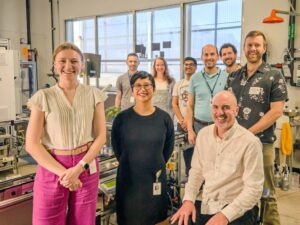
The Breeding Insight and Danforth Center teams toured the Bellwether Phenotyping Facility, a state-of-the-art research space where scientists use automation and conveyor systems to measure plant traits, or phenotypes, across thousands of plants. Photo courtesy of Edwin Reidel. Front row, from left: Katie Murphy, Malia Gehan and Edwin Reidel. Back row, from left: Marcus Griffiths, Keeley Brown, Parag Bhatt, Noah Fahlgren, Arlyn Ackerman and Tyr Wiesner-Hanks.
“The Danforth Center brings deep expertise in plant phenotyping and open-source software development through PlantCV, along with phenotyping facilities and tools,” said Katie Murphy, director of the Danforth Center’s phenotyping facility. “Breeding Insight brings expertise in imaging and strong, direct relationships with breeders across many crops and species. Together, we can build tools grounded in real breeding needs and get them into the hands of the people who use them.”
The visit builds on an existing collaboration supported by a National Science Foundation grant awarded to the Danforth Center to strengthen the community around open-source plant science software. A key focus is Plant Computer Vision (PlantCV), an open-source image analysis platform that helps researchers measure plant traits and better understand how plants respond to their environments.
As plant imaging technologies generate increasingly large and complex datasets, researchers face a growing challenge: translating those images into actionable insights while maintaining the tools needed to analyze them. The PlantCV project seeks to bridge that gap by supporting long-term software development, training contributors in open-source best practices and building a collaborative community around plant image-analysis tools. By reducing duplicated effort and strengthening shared infrastructure, the project aims to accelerate innovation in plant phenomics and crop improvement.
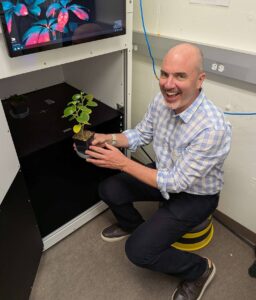
Edwin Reidel, phenomics coordinator at Breeding Insight, examines a plant with the PlantExplorer PRO+ by Phenovation, a tool for plant phenotyping and photosynthesis measurements. Reidel, who previously worked with companies that supplied equipment to the Danforth Center and connected them with Breeding Insight, says the visit brought together several of the most rewarding aspects of his career. Photo courtesy of Edwin Reidel.
Building on these shared goals, the teams discussed tools to strengthen image analysis and data interpretation. Edwin Reidel, BI phenomics coordinator, presented methods for accurate and reproducible color imaging, helping address a challenge the team had been working to solve: how to quantify color differences in images. Following his presentation, Josh Sumner, a data scientist at the Fahlgren Group, developed new PlantCV workflows that incorporate these methods to measure perceived color differences.
Tyr Wiesner-Hanks, biometrics coordinator at BI, is contributing code to expand PlantCV’s measurement capabilities. He is developing a new option to measure length and width based on orientation, complementing the software’s existing ability to measure the height and width of vertically aligned objects. This will give researchers more flexibility when measuring objects positioned at different angles.
Looking ahead, the teams will continue to share knowledge about phenotyping technologies and workflows. BI plans to contribute modules to PlantCV and explore ways to combine plant imaging data with artificial intelligence and high-performance computing resources, including the University of Florida’s (UF) HiPerGator supercomputing cluster. Feeding the data into AI tools would allow researchers to analyze complex datasets more efficiently and more accurately characterize traits important to breeders.
“Combining Danforth’s platforms and expertise with the computational power of UF’s HiPerGator through Breeding Insight gives us an opportunity to open black boxes that traditional phenotyping has largely avoided,” said Arlyn Ackerman, BI plant breeding coordinator. “We can explore high-dimensional datasets to determine whether they can help better quantify and characterize the traits breeders care about, then test whether those findings hold up in breeding trials across the networks that both organizations support.”
Murphy also sees significant potential for the partnership to expand the impact of both teams’ work.
“I’m excited about the future,” she said. “Ultimately, we’ll be able to help breeders measure traits faster, more efficiently and more accurately, from whole plants down to berries and fish eggs.”
____
By Megan Sam
Posted: November 16, 2026
Last updated: November 16, 2026