
Cucumbers are a beloved staple in many of our favorite salads, but this crunchy and tasty side–dish ingredient wasn’t always the beloved domesticated produce that we think of today. Less recognizable wild cucumber relatives still exist and are often used to help scientists bring much needed disease resistance to one of our favorite vegetable–like fruits. Crossing a wild cucumber with a commercial variety can deliver increased disease resistance, but it can also drag along unwanted traits including bitter fruit, off-schedule maturity and lower yield. Breeders and researchers often had limited ways to identify those hidden genetic tradeoffs. They had to wait full growing cycles, select their favorite contenders based on favorable traits, cross those plants and start again.
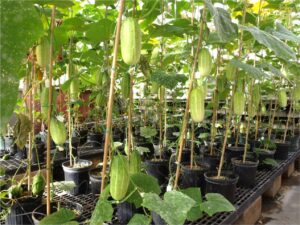
Cucumber plants growing inside a greenhouse at a breeding program site in Madison, Wisconsin. Photo credit: Yiqun Weng
Now, an open-access marker panel developed through a collaboration between Breeding Insight (BI) and the USDA Agricultural Research Service (ARS), gives researchers a clearer picture of the cucumber genome and allows them to select for desirable traits while avoiding unwanted ones.
In 2023, Meng Lin, bioinformatics coordinator at BI, and Yiqun Weng, USDA-ARS research geneticist and professor at the University of Wisconsin-Madison, began to develop a mid-density genotyping tool that breeders could easily use. Although scientists had previously identified numerous genes and quantitative trait loci associated with important cucumber traits, breeders had lacked an affordable, efficient and routine way to screen plants for those ideal genetic regions and incorporate that data into routine breeding decisions.
The panel would address a longstanding gap between genetic research and practical cucumber breeding. Without genetic markers, breeders must rely heavily on growing and evaluating plants to determine which traits they have inherited. The panel allows breeders to identify desirable genetic regions and track them through successful generations of new plants, recover desired traits faster and avoid unwanted genomic baggage.
The now successful and tested public platform includes 3,061 markers spanning 250 previously reported genomic regions associated with disease resistance, but also equally as important traits like fruit quality, skin texture, plant architecture, sex expression and yield. By screening for multiple genetic regions at once, breeders can target and stack multiple desirable trait regions into new varieties simultaneously, cutting research and breeding time significantly. The downstream effect this has is immense. Smaller breeding and research programs can now access the data quicker, easier and turn it into real time breeding decisions, saving time and effort.
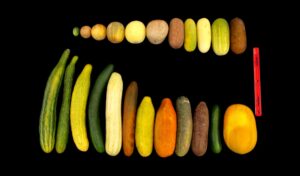
Assorted cucumbers for research purposes. Photo credit: Yiqun Weng
“This cucumber 3K SNP panel is valuable for many marker-based applications for both cucumber breeders and the broader research community,” said Yiqun. “It offers moderate throughput alongside high accuracy and reproducibility. Data analysis of the genotyping results is straightforward and breeder-friendly and does not require sophisticated bioinformatic tools or skills.”
The panel also boasts an additional valuable asset that cuts researchers’ time and effort again. Often when genotyping, researchers use leaf tissue, meaning the plant needs to grow and produce leaves before sampling can be done. Researchers successfully applied DArTag technology to seeds, in addition to leaves, allowing breeders to genotype plants before they reach maturity.
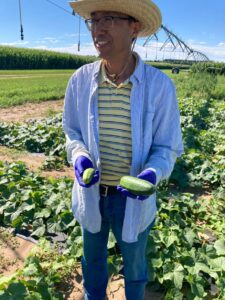
Yiqun Weng, USDA-ARS research geneticist and professor at the University of Wisconsin-Madison in the Madison program cucumber fields. Photo credit: Craig Beil
“The ability to utilize either fresh tissues or half-seeds as the genomic DNA source provides breeders with some flexibility in project planning, too,” said Yiqun. “Breeders can now identify promising candidates earlier, before plants reach maturity, and make selection decisions sooner. This can reduce the greenhouse space requirements, lower labor costs and save weeks on the breeding timeline.” That means consumers get cucumbers on their plates quicker, with more of the traits that they love the most.
Meng is also hopeful about the broader impacts of the panel.
“Looking ahead, we hope this resource will become valuable not only to individual breeding programs but also to the broader cucumber research and breeding community,” she said. “By making genetic information more accessible and actionable, we aim to create new opportunities to explore genetic diversity, identify and utilize valuable alleles and make more informed breeding decisions. Ultimately, we hope this resource will accelerate genetic gains, strengthen collaboration and contribute to the development of improved cucumber varieties for future needs.”
To learn more about using the cucumber marker panel in your breeding program, contact bi-science-team@ufl.edu.
—
By Kristen Lind
Posted: November 17, 2026
Last updated: November 17, 2026